

Update: The UT is updating a paragraph of the story on California’s rainy day fund, after citing The Treasurer who gave an incorrect value during the interview. This error did not appear in the print edition of the story. We apologize for the error.
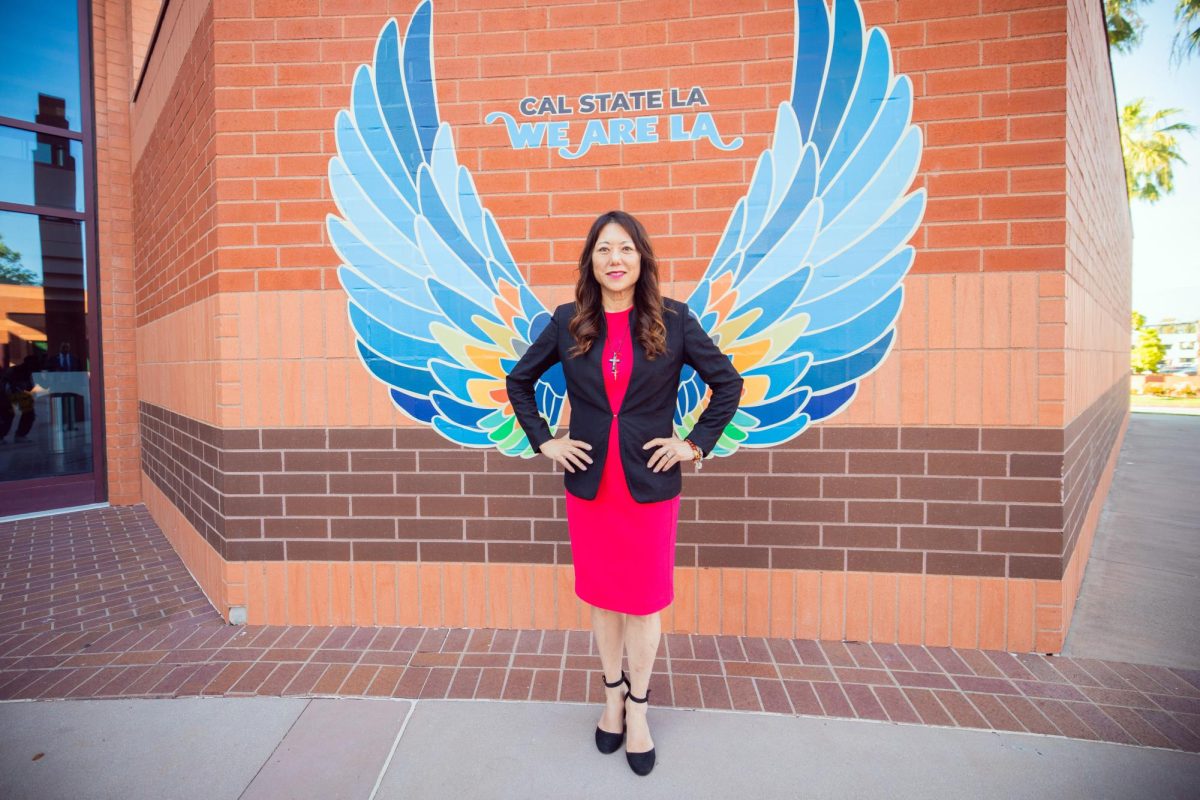
By touring the Cal State LA campus and various programs, California State Treasurer Fiona Ma was right in her element, out in the community and making sure everyone had access to the financial resources they needed.
Following the excursion, Ma sat down with the University Times (UT) for an expansive interview recapping her time as state treasurer, along with the joys and challenges of the office.
“More importantly, my dad is proud of me that I am the banker for the fourth largest economy in the world,” Ma said.
The Treasurer is one of eight constitutionally obligated statewide officers, who once handled all of California’s gold. Now the office oversees California’s nearly $3 trillion in yearly transactions. Beyond overseeing every local dollar, the Treasurer also handles the state’s investment portfolios and excess funds that the state’s Controller Office does not allocate. They also handle “the extra money” for the 2,200 local governments in the state.
Ma was first elected to the position in 2018, and set the record for the most “yes” votes for the California Treasurer position, with 7.8 million voting for her. She is also the first woman of color to hold this position. She was re-elected in 2022. Ma terms out this year and is now running for lieutenant governor in this year’s elections. In her time in office, California’s economy has grown from sixth in the world to fourth, according to the Treasurer’s office’s own documentation.
Ma attributes that economic growth to California’s entrepreneurs, the state’s diversity, and its large immigrant population.
“Everybody wants to strive and work and succeed and create, and that’s what makes California the golden state that we are,” Ma said.
Before being elected to the Treasurer’s position, she started out as a Tax Accountant, sitting in her office 16 hours a day, and meeting deadlines every month, which she said didn’t fit her personality.
“So even now, I’m not in the office a lot because I am out in the field talking to people, touring, meeting, seeing, promoting all the things that are good in California,” Ma said.
She has held three other political offices before being elected, as a member of the San Francisco Board of Supervisors, the State Assembly and the State Board of Equalization.
During her time as a member of the state assembly from 2006 to 2012, she authored 60 bills that got signed into law, which addressed public health, environmental protection, domestic violence, and the rights of consumers.
She is the first Certified Public Accountant to hold this position.
“I think this job has really combined all of my professional experience working as a real estate tax accountant, as well as all of my other elected positions,” Ma said.
Current lieutenant governor Eleni Kounalakis is one of several who are running for the position in the June Primaries, and she has been officially endorsed by Ma.
“She is very accomplished as a business woman in real estate,” Ma said. “She was the former ambassador to Hungary, has done a very good job handling international relations for the state of California, but also has a business and a financial mind, and that’s what we need here at the treasurer’s office.”
But for Ma, having both public and private industry experience was important for her and the office of deputies and staffers, because “time is money.” Because of this, Ma also said that investors are “happy.”
“I think the Treasury’s office is running really well right now,” Ma said. “It’s easy to access our funding programs, and we help a lot of people.”
Ma said that touring public universities and schools across California was about seeing how each of these campuses are doing, and ensuring these schools are “thinking about the future.” The success of the public higher education system is especially important to Ma, because of her own roots as a product of the public school system, and her mother who taught art at a public school.
“Many companies come to California because of our talent pool,” Ma said. “We need to make sure that our kids are getting the best education.”
While at Cal State LA, Ma visited several programs that are working to build a strong future for students, including the Prison Graduation Initiative (PGI). It was introduced in 2016 at the state prison in Lancaster. The program later expanded to the California Institution for Women in Chino in 2022. PGI was also added to San Quentin earlier this year.
“We went by your prison graduation initiative, which is also amazing in giving people who are formerly incarcerated a second chance to get an education,” Ma said.
Other stops included a check-in with the school President, The Dreamer Resource Center, the on-campus Hydrogen Research and Fueling Facility, The LA Economic Equity Accelerator and Fellowship, and the Associated Students Finance Committee.
However, this was not Ma’s first visit to Cal State LA. Towards the end of 2025, she was on-campus and the host for the Golden State Manufacturing Forum at the school, which was focused on “convening regional industry, workforce, and policy leaders to advance California’s manufacturing economy,” according to the summary of Ma’s visit provided to the UT by the school.
Ma, when speaking about the various programs she’d visited throughout the day, said that Cal State LA was “number one in graduating folks with a bachelor’s degree.”
The school also promotes this as a fact on their website, saying that they’re “number one in the U.S. for upward mobility of our graduates,” adding that Cal State LA is “the best university in the nation at helping our students earn their degrees and propel them up the economic ladder.”
When asked about her successes and the programs she’s developed over the course of her term in office, she responded by saying “I’ve got a lot” and “how long do you have?”
The list was indeed very long. It included programs like CalAble, which helps those with disabilities. And post pandemic loans to rural California hospitals that were struggling and were able to open because of these funds from the treasurer’s office.
But some of the programs Ma mentioned really continued to define California’s rapidly changing green policies, including GoGreen Financing. This is a program for residential homeowners, business owners and apartment owners to get low interest loans to “save money on utility costs.” It included benefits for those looking to replace old air conditioning systems, or upgrade to LED lights, double paned windows and other green oriented improvements.
GoGreen Financing also receives funding from the California Energy Commission’s Equitable Building Decarbonization Incentive Program, that puts billions from Cap-and-Trade funds toward reducing “greenhouse gas emissions.”
Ma said that GoGreen Financing was “making a difference for folks.”
Many of these programs came directly from Ma and her passion for these issues, including some focused on foster youth, as well as the unhoused with programs like CalKids, which has, since 2022, been “essentially giving free money” to first through twelfth graders for “free and reduced” lunch. Beyond the reduced lunches, CalKids also features longer term investments in the futures of younger students with millions in annual statewide scholarships that act as seed money for college and their careers.
Through the CalKids program, Cal State LA has received $1.3 million in scholarships.
Ma emphasized the surprising challenges that come with giving away free money. However, she’s managed to partner with local government, non-profits, cities and others across the state to expand their capabilities and communicate to local communities on how to access these funds so that Californians can get the help they need.
“I mean, we’ve just hit all the milestones and more,” Ma said. “The next treasurer will be lucky.”
However, even as Ma said her time in office was successful, it wasn’t always perceived that way by others. Accusations of sexual harassment against her, as well as the potential mishandling of state funds and having to face ongoing questions about the continued “money pit” that California High Speed Rail (CAHSR) has become have also defined her tenure as the Treasurer.
Ma has denied any wrongdoing in all of these instances. However, the state did pay $350,000 out to one alleged victim before the case went to a trial in the summer of 2024.
But with CAHSR, Ma has been a long term defender of the project and made sure it remained on the ballot in 2008, despite the pushback it has continually received. When she visited communities before the project was passed by voters in November of that year, Ma said that many students did not want to be stuck in Central California cities, and wanted an easy way to branch out to other parts of the state.
In 2008, 53% of voters approved of the ballot proposition that officially kicked off the project and began its process towards completion.
Many also questioned why California had not caught up to the high speed rail systems in other parts of the world.
Ma, however, said that the number one issue was that the CAHSR project is not something the government is used to doing or managing. But, other delays like eminent domain–the process of buying private land for a project–and lawsuits are also to blame, Ma added.
She is also working on the Brightline project, which is almost entirely privately funded, and will connect Las Vegas with Rancho Cucamonga with a two-and-a-half-hour train ride, but that has come with multiple stipulations set by the Treasury Office.
Some of those include hiring a contracting firm that is labor friendly, and ensuring that Brightline “alignes all of the tracks, the signals with the California High Speed Rail Authority network, and that they use the same trainsets.”
The Brightline project is set for completion in late 2029, and after that, Ma said she hopes that the company can then help the state finish CAHSR.
“Government is not really equipped to run public transportation systems,” Ma said. “I don’t think any of them make any money.”
Even as the Cal State system continues to be an economic strength for California, Ma says that the ongoing federal funding threat by the Trump Administration continues to challenge the operations of the Treasury and the programs that rely on federal funding.
“It is stressful because when a program is threatened to be cut or money is clawed back, people call us and say, ‘what are we going to do about it?’” Ma said. “‘How are we going to backfill these programs?’”
However, it goes beyond the ongoing lawsuits and fight in courts, because of the work done by former California Gov. Jerry Brown and current Gov. Gavin Newsom, the state has a “rainy day fund” and a short term portfolio which is used as a cushion when programs are cut for a long period of time, Ma said.
The original rainy day value was incorrect, but was updated by the state treasury office in an email after the story was published. The rainy-day fund at the end of this fiscal year is “projected” to be at $11.3 billion and would grow to approximately $14.5 billion at the end of the 2026-2027 fiscal year.
“We are firing on all cylinders when we are attacked, especially California,” Ma said. “We are a donor state. We are the economic engine and the fact that we are not treated with that type of respect as a donor state is very frustrating for many of us here in California.”