

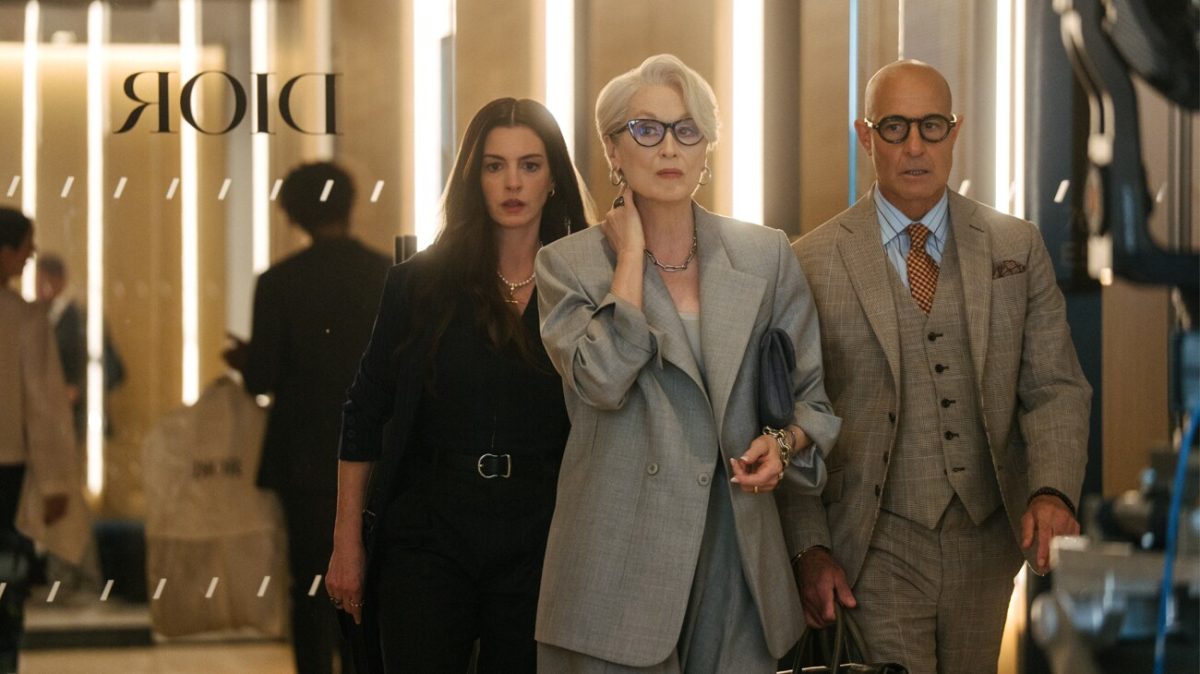
The highly anticipated sequel to the 2006 hit “The Devil Wears Prada” has arrived, and despite journalism being a lesser, but still essential part of the original, this film makes journalism a more central aspect of the plot.
In the original film, Andy Sachs (Anne Hathaway) was the former editor-in-chief of her college’s newspaper, The Daily Northwestern (even if this detail isn’t significant enough to make student journalists everywhere rejoice, the recognition still means something!), and wrote about a janitors’ union, leading her to win an award for her work. Yet Andy’s desire to write takes a backseat to her job as an assistant to fashion magazine Runway editor-in-chief Miranda Priestly (Meryl Streep). Miranda’s high expectations exhaust Andy, bringing her to put in time and effort to meet expectations.
At the first movie’s end, Andy has a successful interview at the New York Mirror, allowing her to finally fulfill her dream of pursuing a journalistic career. She even sees Miranda and gives her a friendly wave. But as she walks off into a crowd of fellow New Yorkers as the credits roll, there’s a certain satisfaction in watching Andy, in her post-Runway future: this main character isn’t just taking steps across the street, she’s taking steps towards a more fulfilling career for herself. And at the sequel’s start, Andy’s career and the difference between it and her job at Runway is what takes center stage.
The sequel kicks off with a sequence of events that are realistic representations of today’s industry. Andy attends a journalism award event, as she and the other journalists of the fictional New York Vanguard are fired over text, just as the nominees of Andy’s category are being announced. When her name is called, she approaches the podium and tells the audience why she is visibly upset, explaining the job loss of her and her colleagues, launching into a fiery speech about the importance of journalism. Andy even mentioned to her friend Lily (Tracie Thoms) that the Vanguard made $11 million in the past year, an irony to the firing of an entire table of the paper’s journalists. This opening moment, and its occurrence at the movie’s start, sets a tone for the story to come: in the modern world, journalists can find themselves in difficult situations due to the change within the industry, whether in the form of technology’s progression, mass layoffs, the financial aspect of publications, or the decline of print media.
The famed magazine where Andy used to work, Runway, had published an article that praised a fast fashion company, SpeedFash, landing editor-in-chief Miranda Priestly in hot water with the public for not knowing of the company’s sweatshop labor. Even if “SpeedFash” was an incredibly lazy name for a company, it does make for a name that is straight to the point about what the company produces: fast fashion, or otherwise, poorly made and inexpensive clothing.
To that point, it doesn’t make sense for fast fashion to be something that was written about in Runway if it’s been established that it highlights designer brands. If Dior is a main advertiser in the magazine, as a part of the sequel’s plot explores, and a majority, if not all, clothes involved in Runway’s photoshoots come from high-end brands, how would a fast fashion brand land itself a mention in a fictionalized version of Vogue Magazine?
It would have been nice to see at least one image or visual reference of the article that got the magazine in trouble, even if it was a puff piece, as it would’ve made it more believable as part of the plot. I wondered how long this article was, what the photos provided in it were, or what about the company’s clothes made it worthy of any praise. Yet the movie only allowed for a number of mentions of the article and how problematic it was. Instead, there is a lot of focus on social media’s response to the magazine’s blunder. An image of Miranda as a fast food worker with the caption, “Would you like some lies with that?” along with an animated video of a cartoon, Simpsons-inspired Miranda disappearing into the bushes, are among the responses. These were clever touches, as they reveal the impact that public reactions can have in response to media scandals, and how important figures in the media can truly serve as the face of their institutions. Even though Miranda herself didn’t write that article, her name is so synonymous with Runway that she practically serves as its sole representative, though as editor-in-chief, her attention to the article could have prevented the scandal.
Andy is named the new features editor at Runway when Irv Ravitz (Tibor Feldman), the owner of the magazine’s parent company, contacts her after his son, Jay (B.J. Novak), showed him the video of Andy’s speech. When Miranda learns from Andy that she is now the features editor, Miranda makes a call to tell a character we assume is the current features editor that she won’t be needed anymore and must pack up her things. These words from Miranda are cruel yet comical, as there’s some irony to the fact that Andy had recently been fired, and her new position led to someone else’s firing. Andy’s offer for the job didn’t require an interview with Runway, fortunately, since, realistically speaking, a recently fired journalist would likely not be given an impressive offer without any effort. Still, the firings in this movie demonstrate the uncertain nature of media employment and that job security isn’t exactly permanent.
As the features editor, Andy throws herself into her work, writing and publishing more substantial articles to the magazine online, as the print edition has fallen out of favor, and the magazine’s online content is what will bring readers in. She even writes a statement of acknowledgement regarding the problematic SpeedFash article. It was incredible to see Andy’s dedication to her job, as she was putting in the work to revamp Runway and improve the types of content that readers have access to. Seeing her as a hardworking, talented features editor felt so fulfilling, a stark contrast to her job in the first movie, where she was bossed around by Miranda mercilessly and frequently found herself in unfortunate, stressful situations. When Andy gained this position, the amount of power she had was closer to that of Miranda’s than ever before. But even though Andy holds the position of features editor, Miranda assumes that she’ll fail at this, an interesting sequel counterpart to the way that she doubted Andy in the first movie. Thus, this lack of belief in Andy as a journalist goes beyond the fact that she is now writing for Runway and showcases that Miranda’s impossible standards remain.
Additionally, Andy can also afford a new apartment due to her job at Runway, making twice as much as she did at the Vanguard, a major plus since the apartment she was living in at the movie’s start had brown water coming out of the bathroom faucet. The salary aspect of the plot highlights how a person’s lifestyle can be impacted by how much they make, and the position at Runway managed to help Andy tremendously.
Andy describes that she had followed interesting stories all over for 15 years since leaving Runway, which seems like an especially impactful detail in the life of this character: she managed to not only succeed in the career she had been devoted to after leaving the assistant job, but also had the opportunity to travel frequently, while continuing to work hard chasing stories. This detail, while not expanded on, stood out due to the fact that it showcased where Andy’s career was able to take her.
The aspect of the plot involving Andy’s goal to secure an interview with Sasha Barnes, the ex-wife of billionaire Benji Barnes (Justin Theroux), was a valuable factor in the storyline. Since Miranda had never been able to get Sasha to agree to an interview, Andy attempts to do so in order to impress the editor-in-chief, making several phone calls to track down Sasha. She mentions to her friend Lily that she left 18 voicemail messages for Sasha, which, to a non-journalist, sounds obsessive. Yet when taking into perspective the significance of what this interview could mean, this plot is a signal that Andy is incredibly dedicated to get this interview, and her effort alone is impressive.
Since Andy’s request for an interview is accepted, she and Miranda visit Sasha, one of the world’s wealthiest women, who compliments Andy on her articles. This detail of the plot felt like a hopeful one for journalists, as gaining respect and admiration for your work from anyone is nice, but for Andy to hear it from a reclusive public figure of such high status was significant. Sasha’s praise for Andy’s work– and the fact that she praised Andy in front of Miranda– was a way of signaling that the hard work of dedicated, talented journalists deserves recognition.
This kind of appreciation coming from someone of extreme financial wealth does say a few things about the situation’s context: someone as wealthy as Sasha makes for an unsurprising fan of Runway, as she would be of the income level to afford the items that the magazine features. Yet the situation might also be read as a statement of journalism’s value transcending economic differences: despite Sasha’s status of extreme wealth, and therefore being a great distance from the problems of the majority of the world, Andy’s work was still able to reach someone living an extremely different lifestyle.
There is also a very time-consuming, exhausting part of the plot regarding the parent company being sold and put under new management, which brings visible distress to Miranda. Her position at Runway is threatened, and this provides a plausible conflict for the otherwise undoubtedly powerful character. To see regular journalists lose their jobs didn’t feel as surprising, but the potential ousting of Miranda, the rightful face of her magazine, showed that in the world of media, no one’s position is unshakeable.
What might have helped this storyline be more enjoyable would have been less scheming and planning of what Runway’s future looked like (whether in terms of trying to save it or restructure it), and more concentration on how others reacted. Had the story of Runway’s potential fate been leaked to the public, it would have been interesting to see how other journalists, publications, and the public reacted to it. If Runway had shifted to online content and other publications had as well, it could’ve been fun to see the kinds of social media reactions that were shown in response to the fast-fashion controversy earlier in the movie.
Additionally, the movie highlights the mingling of billionaires in the world of media. The unrealistically clueless Benji Barnes, who at one point makes a statement about visiting the sun (because any reference to billionaires in movies or TV now must be coupled with a reference to space travel), is a prospective buyer of Runway. His potential to purchase Runway proves to be an issue, as he mentions to Miranda that soon enough, the magazine won’t “need models, locations, or even designers,” and that AI will replace them all. This is the nightmare of many people: that AI will replace essential facets of an industry so driven by human creativity. The words of Miranda’s reply even juxtapose what Benji said, mentioning “human achievement,” a reminder of how much effort and heart are put into the print and publishing industry.
One new character didn’t get enough of a story in the movie, though he really deserved one: Andy’s friend Mack (Larry Mitchell), a colleague from the Vanguard. He is next to Andy at the table when the paper’s journalists are fired, even appearing a few times after the firing, sitting with Andy as she attempts to figure out where to start on tracking down a way to contact Sasha. What was great about this character’s inclusion in the plot was that his connection with Andy mirrors the way that journalists can and do support each other. I wanted to know if he would be able to find a high-paying job that would require his skills the same way that Andy did, even if it isn’t realistic for journalists to have opportunities suddenly provided to them.
So while this ultra-hyped sequel has plots that take it in a variety of directions, one throughline is that journalism, a valuable piece of our ever-changing world, may be under threat, but that is exactly why it deserves your attention. Even if fashion is what many see as the center of both the first and second movies, it is worth recognizing that without journalism, Runway Magazine and the memorable characters that surround it wouldn’t exist.