

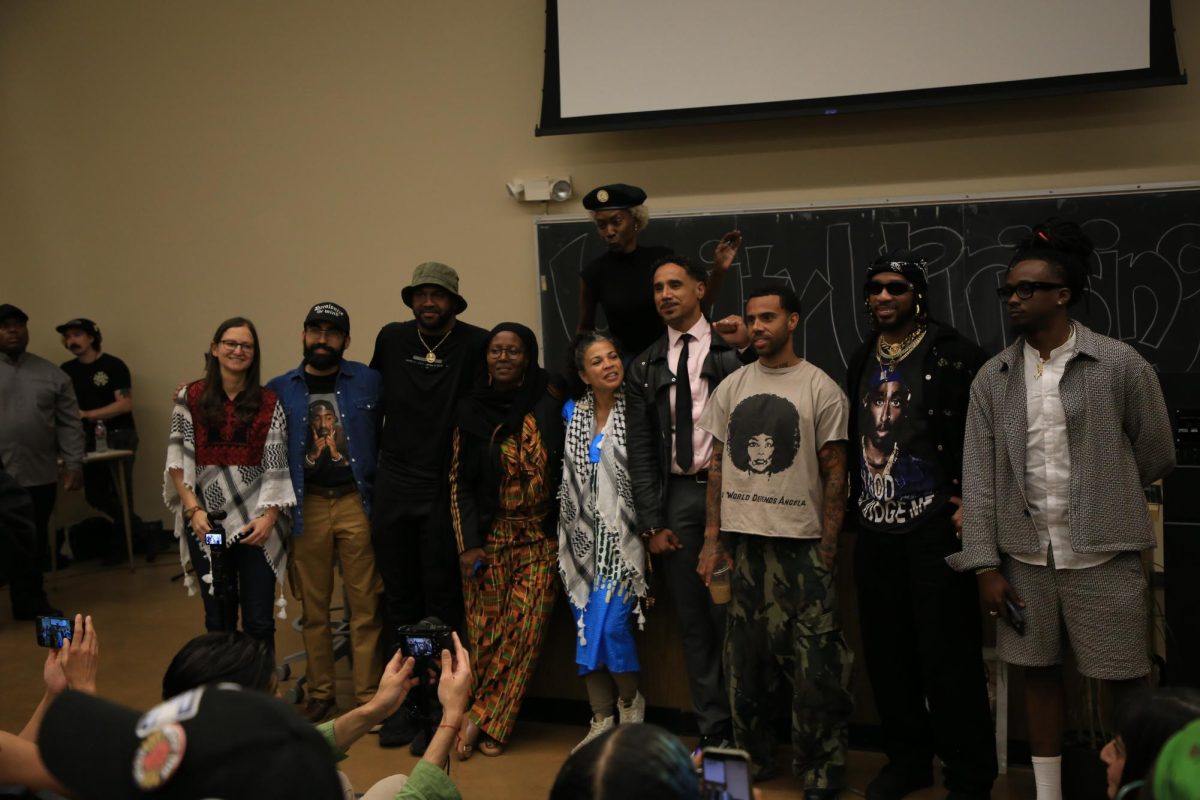
The Unity Uprising event was held at Cal State LA’s Martin Luther King Jr. Hall on April 4, marking 58 years since MLK’s assassination and celebrating a day of “Black radical traditions and collective liberation.”
The day of panels, the keynote and the reception was hosted and organized by University of California Santa Barbara (UCSB) History Professor and California gubernatorial candidate, Butch Ware and Melina Abdullah, a professor in the Pan-African Studies Department at Cal State LA and co-founder of Black Lives Matter Grassroots.
Multiple groups were in attendance, including the California Faculty Association (CFA), The College of Ethnic Studies and a volunteer group supporting Ware’s run for Governor in the state.
This event was a set of two panels and a keynote speech with a modern focus on “the great convergences of the 1960s” when leaders like MLK Jr., Malcolm X, the Black Panthers, and thousands of others “held in tension the full complexity of Black freedom struggle, and lit the path to collective liberation.”
Both Abdullah and Ware pointed out their connections to campuses with significant ties to the Black revolutionary movement of the 1960s. King Hall, which was originally known as North Hall, was renamed in November 1968 in honor of MLK. The on-campus newspaper, the College Times, which later became the University Times, reported on Nov. 25, 1968 that then School President John Greenlee said, “North Hall was selected for the renaming because it houses the School of Letters and Sciences, academic areas which were of special interest to the late Dr. King.”
Not long before the renaming of Cal State LA’s North Hall in October 1968, UCSB’s North Hall was temporarily renamed to “Malcolm X Hall” after 12 Black students took over the building for 12 hours, which “forced the UCSB administration and surrounding community to acknowledge the needs of Black students on campus,” according to the Daily Nexus, UCSB’s student-run newspaper in a special commemorative report in 2018, 50 years on from the occupation. It also led to the creation of UCSB’s Pan-African studies program, according to Ware. The building, however, did not get permanently renamed and is still commonly known as North Hall.
The afternoon and event opened–beyond the mingling at the beginning–with a Libation from Abdullah, as a way to recognize that “we are not the first people here” and “not the first ones to struggle.” A Libation is a long practiced religious tradition where a person pours liquid–often wine–as an offering of sacrifice to a deity, ancestors or spirits that have passed on. At the event, water was used and poured into a plant at the front of the lecture hall where the festivities took place.
In this Libation ceremony, Abdullah said that the offerings would be made with three distinct groups in mind, beginning with what she called the “most righteous warrior ancestors.”
Each of these three groups that were named before the ceremony began had significant ties to what the Unity Uprising event was about. The final two groups that would be honored were those that were “martyred” and family ancestors and spirits that move with us and “inspire us” to wake up everyday “as we move forward to make the world what our god imagines it to be and uses us to make it.”
Every single time the water was poured, a name was called by a participant in the room and repeated by the rest of the crowd and Abdullah.
The three events included the first panel, “Radical Politics, Organizing and Movement Building.” The second panel was titled “Rebel Culture, Arts, and Maroon Media. The later keynote which wrapped up the day led by Ware was titled “Soul Power: The Past, Present, and Future of the Black Revolutionary Spirit.”
The first panel had several well known labor organizers and a former top politician, as well as Chris Smalls, a well known activist for workers’ rights that led to the creation of the first U.S. Amazon union at the Staten Island warehouse he was fired from in 2020. He is also a major voice for a “free Palestine” in the labor movement and was on the Handala Freedom Flotilla last summer which was a part of an effort to break Israel’s ongoing siege of Gaza.
Because of that, Smalls was banned from Israel for 100 years, which he wears as a “badge of honor.”
“The answer is the power of people when we come together,” Smalls said about a gathering like the Unity Uprising. “There’s no amount of money in the world that could defeat the power of people. And even the richest man in the world, the richest companies, which is corporations, billionaires, they still can’t figure this shit out.”
But to that point, Smalls said that we as people have to go so much farther and go beyond the No Kings protests and build towards radical action, to take the duopoly down. The duopoly refers to the “death grip the two party system” has on this country, according to Smalls.
“What’s happening here in America is we are part of a two-party plantation and we have to find a way out right now,” Smalls said. “We’re running out of time and our oppressors are accelerating shit by starting these wars and bombing them all over the place.”
Others on the panel included Abdullah and Nina Turner, a former Ohio Senator and Democrat. The final panelist was Fernando Deveras, a community organizer and educator in local communities.
This was a sentiment that was shared across the four panelists.
“There’s more of us than there are of them,” Abdullah said, referencing the power of the people. “We will not feed the two-party system. We will not feed the duopoly.”
But, for others, it’s a matter of still having hope.
“Hope is a motivator and as human beings we need to always believe,” Turner said. “The moment we stop believing is the moment we stop moving. So hope is the motivator. This is the hope. That is what we do with that hope. So that’s what we’re doing right. They’re gathering like this all over the country on a regular basis.”
Turner also emphasized the fact that to move this movement forward for liberation of all, everyone has a role to play and is a part of the team.
“But I say universally our role is not to continue to take this madness,” Turner said. “We have got to understand that the lesser of two evils is still evil.”
Some of this radical politics that was expressed during the panel called out collaborating with any state entity and by taking steps against racists and those that protect the rich and powerful is the righteous position, Abdullah emphasized.
“Fuck the police and ICE every time,” Abdullah said.
The second panel focused on the arts and the value of political arts as acts of resistance with four new panelists that included Conscious Lee, an educator, facilitator and digital storyteller. The second panelist was Vic Mensa, an American rapper from Chicago involved in the liberation movement.
“I would say that art is inherently political,” Lee said. “And I think when we talk about power, it’s the reason why so much art is dictated by systems.”
But Lee added that art that challenges those very systems and is “capturing the reality we live in and in spite of institutions” is very different from art that does not challenge the status quo, which Lee defined as propaganda.
The other panelist that joined Lee and Mensa was Angelica Ross, an actress, producer and advocate for the transgender community. To cap it off was Van Lathan Jr., who is a journalist, podcaster, political commentator, and had worked in the past with TMZ.
“I redefine celebrity by celebrating people who have done some amazing things in my community,” Ross said. “Those are my celebrities.”
To wrap up the day, Ware held a keynote that explored the power of spirituality and the ancestral traditions in the revolutionary struggles of the present day and in the past.
“As soon as you kill the inner colonist in here, as soon as you make your own assessment of the situation, unfettered by the imaginary chains that your oppressor has placed on your consciousness, then liberation becomes not impossible, but inevitable,” Ware said. “And part of what gets us free in here is reconnecting with that which is sacred, reconnecting with that which is indigenous.”
Ware closed the day and his keynote with a moment of wisdom and reassuring everyone that people have the power.
“By developing our culture, our arts, our expression, and our spirituality, we become more effective weapons or resistance, which brings us back to where we started,” Ware said. “Heal. Spend time with those scholars and teachers. Sit at the feet of spiritual masters.”