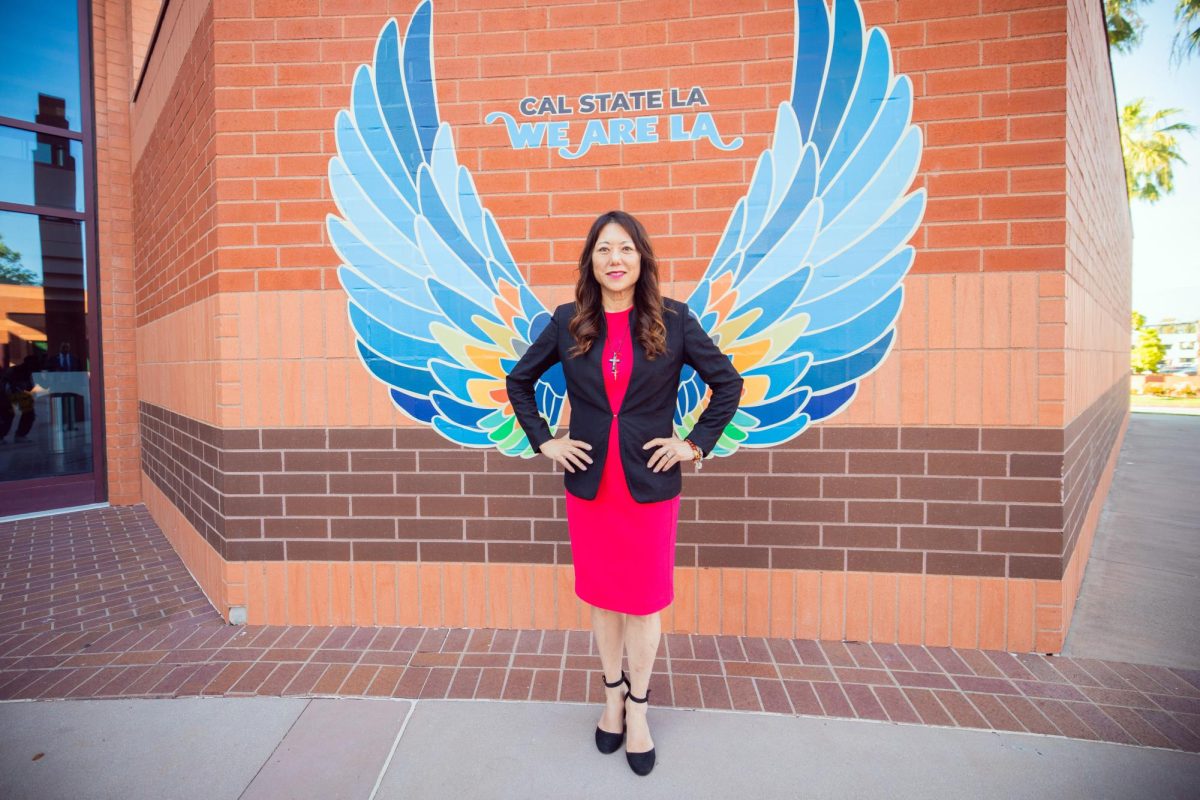



California Secretary of State Shirley Weber’s mid-November visit brought a genuine warmth to Cal State LA’s Student Union Theatre, transforming the spacious room into a welcoming, intimate environment. Students, faculty, and other members of the Cal State LA community gathered for an inspirational conversation about leadership, activism, and the importance of representation.
The program was hosted by Associated Students Inc. (ASI), and was organized by Diana Rangel, a Chicana studies major at Cal State LA, who is also ASI’s College of Ethnic Studies Representative. Rangel had noticed that students on campus were seeking community, representation, and genuine conversations with leaders who understood their struggles. Rangel shared that after attending numerous meetings and listening closely to students’ needs, she realized something was missing.
“I felt like I noticed a lack of community, representation, and support,” Rangel said.
She told the audience how that realization pushed her to dream bigger. Unsure where to start, she reached out to Barnaby Peake, the executive Director of ASI.
Rangel asked if she could host an event on campus, then added that she wanted to invite the California Secretary of State herself.
To Rangel, Weber was an inspirational guest because her life story and achievements were similar to what Rangel hopes to accomplish in her own academic and community work. As someone studying Chicana studies and committed to serving marginalized communities, Rangel saw herself in Weber’s resilience, scholarship, and public leadership.
She was surprised when she got a yes.
“I was like, ‘that easy?’” Rangel said.
Rangel reflected on how the planning took place with the support of Weber’s staff, especially Weber Chief of Staff, who held her accountable and encouraged her throughout the entire process.
Rangel thanked ASI, the Black Student Union, her Chicana Studies cohort, and her coworkers for supporting her during the months of preparation. She also acknowledged her mother, who had reminded her that she is breaking generational barriers and becoming a role model for her own family.
“This event was never for me,” she said. ”“This is for you, because the community always comes first.” She told the audience.
The sense of community was strengthened as the audience learned about the powerful history behind Weber herself. Born to sharecroppers in Hope, Arkansas during the Jim Crow era, Weber’s early life was marked by racial violence, as her family fled to California when she was only three years old after her father was threatened by a lynch mob. Weber explained that her office always pairs civil engagement with history, because people often forget how long and dangerous the struggle for civil rights has been. She reminded students that ethnic studies programs exist only because earlier generations risked expulsion, careers, and safety to fight for them. “You are the beneficiaries,” she told the audience. Those experiences shaped the foundation of her activism and the strength behind her public service.
Weber explained that growing up, she didn’t have the constant media presence that today’s students grew up with. What she had were teachers, neighbors, and church members, who made sure she had love and guidance.
“I saw people who were in my community who were really amazing teachers,” she said. “They took advantage of every opportunity to give me some of what they had.” She noted, “Those are people I gave my energy to.”
She reminded students that community is built through simple acts such as a compliment, kind words, or a small push forward. Those moments, she said, can change someone’s life.
Weber attended UCLA, earning her bachelor’s, master’s, and doctorate degrees by the age of 26. At the age of 23, she became a professor at San Diego State University, where she taught for 40 years and served multiple terms as department chair in the Africana Studies department. She also taught at Los Angeles City College and Cal State LA, making her return to campus feel like a homecoming to many of those in the audience.
She went on to share Cal State LA’s history, and how it was one of the second universities to have a Pan-African studies department, since students fought for this space and the fight isn’t over, according to Weber.
Weber served four terms in the State Assembly representing the 79th District, chaired major committees, and became the first African American person to chair the Assembly Budget Committee, and led the Select Committee on Campus Climate. The committee addressed everything from hate crimes to student homelessness and food insecurity. From 2018 to 2020, she chaired the California Legislative Black Caucus, pushing for civil rights and equity statewide.
In 2021, Governor Gavin Newsom nominated her to serve as California Secretary of State, and she was later elected to a full term in the 2022 midterms.
She is the First Black Secretary of State in California’s history, and only the fifth African American to serve as a constitutional officer in the state’s 175 year history. Outside of politics, Weber is a mother, grandmother, and widow, roles she speaks about with deep love and pride.
Even though she has met presidents, governors, and several high-profile figures, Weber said her real role models were everyday people who overcame hardship and still uplifted others.
As a part of the event, before Weber’s appearance, students were allowed to ask questions. The conversation started when Weber was asked if there were early aspirations of people who influenced her as a child. She went on to reflect on people who shaped her long before she ever imagined becoming Secretary of State. She speaks about the everyday people in her community, the ones she saw in the projects and the Pueblos, long before she ever stood on a stage as an honored guest. One of her greatest influences was a woman named Eva Wilson, a community member who embraced Weber’s family when they moved to San Diego with no relatives nearby.
Weber described how Wilson cared for her children and looked after her home, becoming the kind of village member who shows up without being asked, even decades later.
“That’s a role model,” she said. “Not somebody you’ve never met, but the man across the street who takes care of his family.”
Another question addressed to Weber was how African American studies can continue to grow and hold their ground in today’s political climate. She acknowledged that the moment is difficult, but she pushed students to see their own responsibility in shaping this era.
“People always say they would’ve fought in their 50’s or 60’s,” she said. “Well now is your 60’s, now is your time.”
Weber told students that generations before them faced far worse without the protection or resources people have now, and that with today’s opportunities comes a responsibility to act.
“We have the resources to make a difference and we must use them to challenge this nation,” Weber said.
At the close of the event, ASI surprised Weber with a special honor. To recognize her decades of work in education, community empowerment, and public service, ASI announced the creation of a new annual recognition, The Origins and Leadership Award.
The award’s inscription reads “For a lifetime of service and advocacy, empowering communities and uplifting voices.” On behalf of the students of Cal State LA and the number of students she has inspired throughout her career in the CSU, ASI presented Weber with the 2025 Origins and Leadership Award, naming her its very first recipient.