


Across the CSU system, presidents, executives and administrators continue to receive pay raises, including the approvals for further performance-based bonuses that are now “uncapped” after an amendment was passed to raise compensation amounts at the November 2025 CSU Board of Trustees meetings.
“It’s absolutely hypocritical to tell your workers that you can’t afford to pay them more and then to give huge raises and incentives for your administrators,” California Faculty Association (CFA) member and an associate professor of Special Education, Robin Dodds said. “If they think that they can’t afford to pay us, they should be in solidarity with all of the other workers and refuse to take these pay increases. Because, not only is it bad optics, it’s anti-solidarity.”
This situation comes at the same time that class sizes are exponentially growing, some classes are cut, student tuition continues to rise, professors are laid off, and faculty and staff wages have frozen across the CSU system and at Cal State LA.
CFA LA President Akhila Ananth argued that the 95% of the work administrators are doing “is completely useless” and leaving other important positions across campus unfilled, including admissions officers, the financial aid office and professor positions that contribute smaller class sizes, according to Ananth.
“Those positions are being grossly underpaid, they’re being denied their steps and they are being left half empty,” Ananth said.
Cal State LA Spokesperson Erik Hollins said that the staffing issues were tied to the decreasing state funding for the CSU system, as each campus made 5% cuts to their individual budgets on top of decreasing enrollment. This year, Cal State LA’s enrollment dropped almost 5%, compared to fall 2024, according to enrollment data.
However, Hollins added that “The Division of Student Affairs and Enrollment Management is assessing several areas where there is need for new hires to replace those lost or to add student-services capacity.”
Many have concerns that the timing of these raises for executives and presidents at the CSU are a poor choice, given continued budget cuts and layoffs across the system’s 22 schools.
“It’s just shocking to me, and I think what’s really disheartening is the feeling that there’s no accountability for admin,” Ananth said. “It’s an absolutely damning financial decision for each campus and the system as a whole.”
But the CSU says that they acknowledge the timing concerns, but have said that these hikes in pay are about “catching up” and not “getting ahead.”
Currently, the CSU says that presidents and executive pay continues to lag behind by 25% to 35%, compared to similar systems like The State University of New York, The City University of New York and Texas State.
“While optics are a consideration, the CSU’s priority remains ensuring leadership stability and excellence in service of its students and California’s future,” the CSU said in their FAQ.
Further, the CSU decided to take a $144 million loan provided by the state, but it would be only used to pay all CSU employees with a one-time bonus, and would not be used to make future continual salary commitments or pay unfulfilled contract agreements, according to previous University Times (UT) reporting.
These moves by the CSU system have drawn the sharp ire of on-campus labor unions, accusing the university of not properly paying their workers, while committing more of shirking budget resources towards the pay of presidents and executives.
“Disappointment is an understatement on this decision,” The CFA said in an Instagram post following the decision. “It’s disgusting. It’s disrespectful to all the faculty, staff and students who give their all to this broken system.”
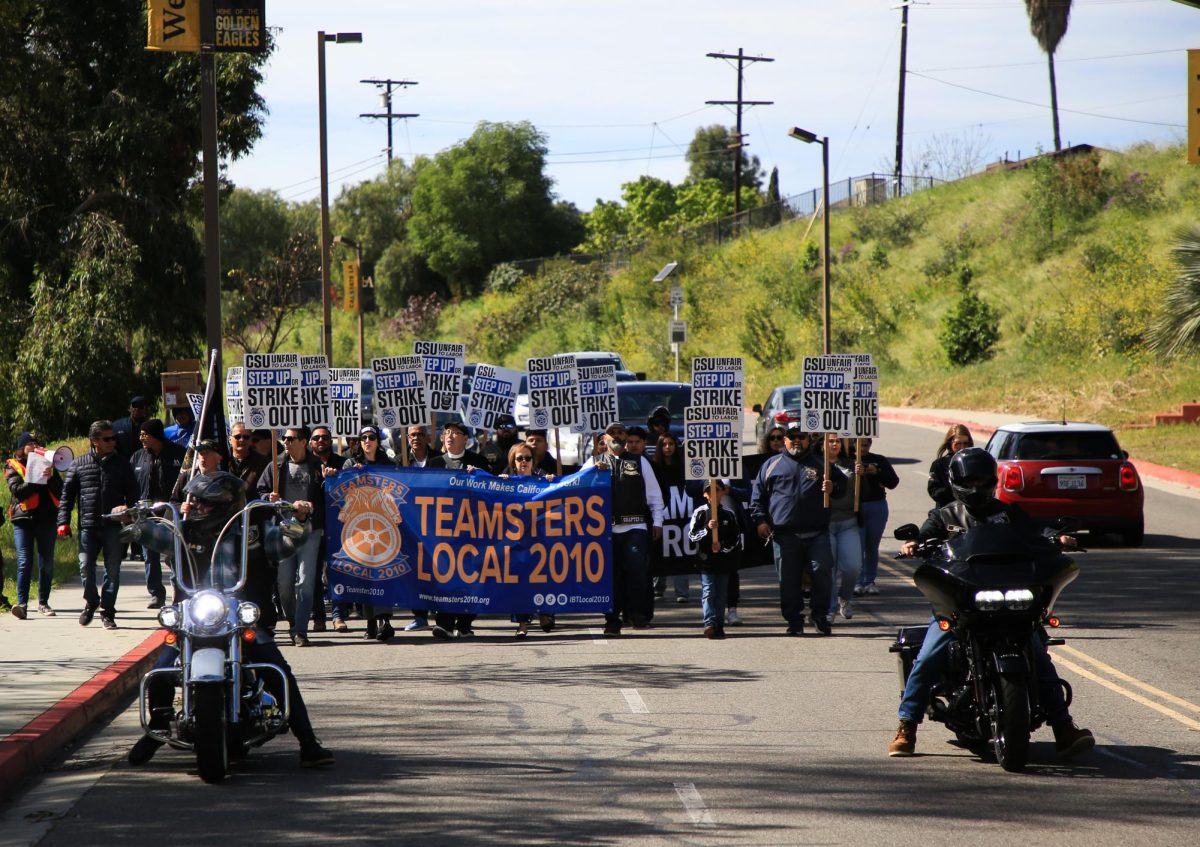
The unions include the CFA, The California State University Employees Union (CSUEU), Teamsters 2010 and the 10,000 Academic Student Workers at the CSU who are represented by UAW 4123, a local of the United Automobile, Aerospace and Agricultural Implement Workers of America.
“While we’re here putting in the work for the students and the campus community, I think it’s an insult that they deny raises that they contractually agreed to,” Dennis Sotomayor, the chief steward of the Teamsters 2010 at Cal State LA, said. “When they give themselves big inflated raises and bonuses.”
The past approvals at the November CSU Board meeting included 5% to 20% raises for 14 out of the 22 CSU school presidents, including an additional 5% raise for Cal State LA President Berenecea Johnson Eanes. Prior to the raise, Johnson Eanes was making $496,213 annually, but after the approvals by the CSU Board that amount went up to $521,024 per year, according to documentation provided to the UT by the Cal State LA chapter of the CFA.
That $521,024 will continue to include an additional $60,000 annually (or $5,000 monthly) for the housing allowance and additional pay for benefits. The raise “retroactively” took effect this past July, according to CSU Spokeswoman Amy Bentley-Smith.
Future raises in increments of 5% could be on tap for Johnson Eanes, but it is “contingent on meeting measurable performance goals aligned with CSU’s strategic priorities and board approval,” Bentley-Smith said.
However, some of what will pay for the deferred salaries and incentive based increase for some CSU presidents will come from “non-tuition, non-state and non-student funds.” There are currently no plans to defer any of Johnson Eanes’ pay.
The 2024 CSU Employees Report, which is the most recent annual overview of the CSU workforce, said that only 16.5% of total employee pay is devoted to president and executive salaries each year. The remaining percentage is used to pay faculty, staff and student workers across the CSU system. Higher level executives and presidents account for just 7.4% of the total CSU workforce, according to the same report.
At the board meeting in November, there was an overview of relocation costs paid in the last two years to CSU presidents included. Johnson Eanes required over $57,000 in associated costs for her relocation, the highest among all CSU executives and presidents listed in the agenda from the Nov. 17 to 19 CSU Board meeting.
“It’s just really shocking that administrators can act with such impunity and they can act with such brazenness,” Ananth said. “They’re not going to get fired for it. They don’t get bumped down steps. They don’t get anything. I wish everyone had that level of job security.”
The highest paid president of the CSU system is Cal Poly San Luis Obispo (Cal Poly SLO) President Jeffrey Armstrong’s, whose income increased to $611,203. The raise will take effect in the next couple years, as previously reported by Mustang News, the Cal Poly SLO student newspaper.
The pay increases also included opportunities for bonuses and increased pay for executive staff of the CSU system and other high level administrators. The cap for maximum executive and presidential pay was also removed as a part of this 20-1 vote and approval by the CSU Trustees. The only one to vote against this resolution was Lt. Gov. Eleni Kounalakis.
Dodds is concerned that these increases to administrator, CSU presidential pay and the “uncapped” potential for bonuses will raise the likelihood of corruption in the CSU system.
Chancellor Mildred Garcia and the Board of Trustees are increasing the pay rates for executives and presidents to ensure salaries remain competitive “in the national marketplace” and to “draw talent to the CSU system,” according to information provided by the CSU on their website.
The CSU claims that the lack of compensation at the presidential level has led to at least six vacancies this year and efforts to fill remaining empty spots has “stalled due to compensation constraints.”
Ananth said that the executives and presidents getting these pay raises are solely invested “in their own benefit” and “own goals.”
“Those goals have nothing to do with Cal State LA students or CSU students in general,” Ananth said. “They’re a professional class. And I don’t have much in common with them,”