

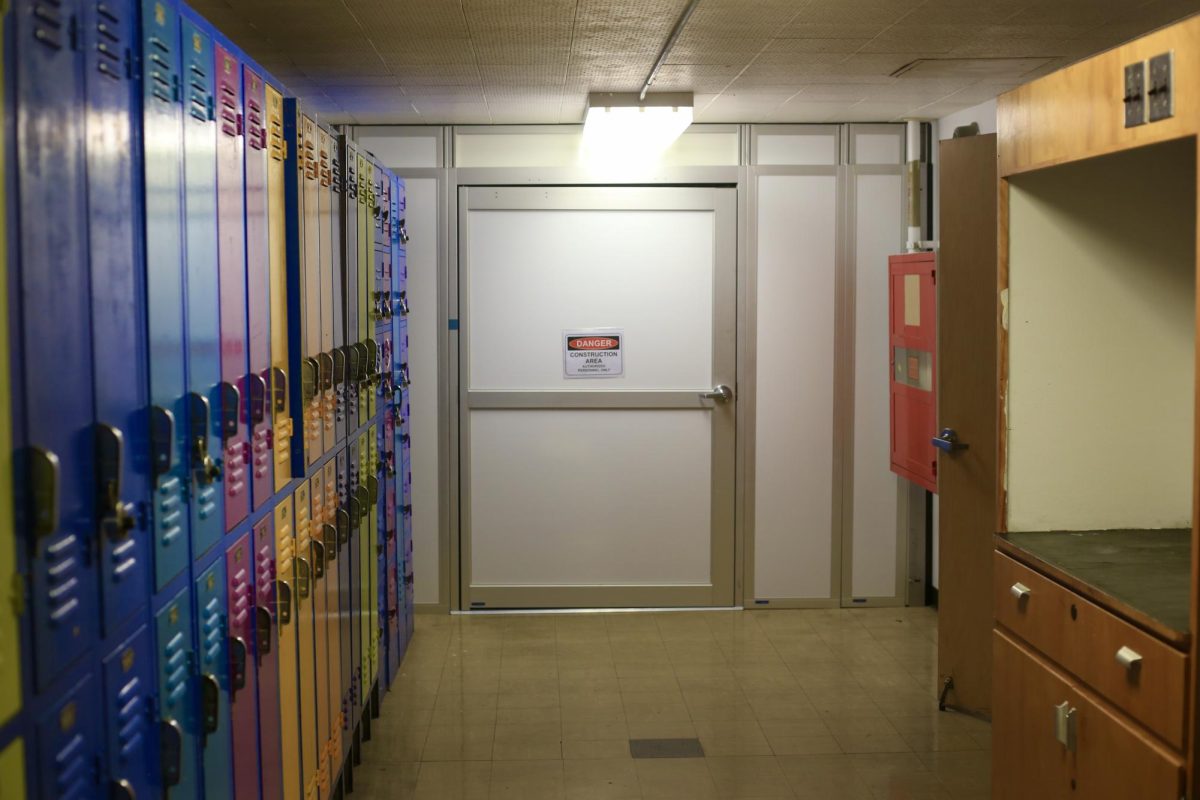
After the flooding incident in the southern portion of the Biological Sciences Building (BSB), the impacted areas will remain closed for the next several weeks, while the drying, assessment and repair process takes place. However, despite the partial return to the building, many classes, science projects, labs and office spaces remain off limits, impacting student learning and extracurricular activities.
When the building was initially closed, 60 to 80 classes a day were impacted, according to Associate Dean of Natural and Social Sciences (NSS) Alison McCurdy and previous University Times reporting.
Only one class in the Biology Department will be impacted by the prolonged closure, and it was relocated to a different building, according to the interim chair of the Department of Biological Sciences, Hyunsook Park.
It wasn’t clear how other departments were impacted by the relocations or the move into fully remote instruction beyond the one in the Biological Department, however McCurdy said that “each class that has been scheduled in the affected spaces are making decisions about whether the class can be offered in an alternative space or offered remotely.”
Further, McCurdy said that faculty members are adapting to support “student learning and engagement” and are also “drawing on their training and past experiences with remote instruction, even for laboratory courses,” to continue teaching during the disruptions to these spaces.
Belfor Los Angeles, who has done previous work at Cal State LA, is in charge of remediating the flooded areas in the structure and determining future risks. However, when asked about Belfor Los Angeles’ previous work, Cal State LA did not clarify when or what those incidents were.
Generally, air quality is periodically monitored across campus and appropriate measures are taken if it rises above certain thresholds, according to the Cal State LA air quality website. The last known test of on-campus air quality in buildings was during the January 2025 Los Angeles wildfires.
In an email before the BSB opened back up, the school said that the areas that are blocked off from the public are not on the same air conditioning and airflow system, meaning that air from where the incident occurred does not circulate with the open portions of the structure.
While professors and others haven’t shared any specific details about the risks to health and personal safety being a concern, there are ongoing air quality testing efforts by the Facilities Department that will be shared to the Cal State LA community in the open portions of the building to monitor for any health risks including future mold, mildew, or building material and or the potential presence of asbestos as the drying, removal and repair process takes place.
The Facilities Department did not respond to questions in time about how frequent the air quality testing would be or when the first results would be released to the campus wide community.
It is now believed that the incident may have been triggered by an emergency shower in a science lab on the third floor of the building at about or slightly before 4 p.m. on Wednesday Oct. 22. Multiple professors who spoke to the University Times (UT) said that they called Facilities and other on-campus services to report the incident multiple times before the facilities department responded to shut the water off.
Cal State LA Spokesperson Erik Hollins later confirmed that the source of the water was indeed an emergency shower.
Cal State LA did not provide any answers to questions about response times to the incident, including whether or not water was shut off to the entire building or just the source of the flooding.
The university did not send the campuswide email announcing a full closure of the BSB until later that same evening, at least a few hours after the initial flooding event.
The emergency showers are typically used when students or professors and their skin or eyes come into contact with hazardous substances or materials that could be corrosive, cause severe irritation, or result in severe or permanent tissue damage or be toxic by “adsorption.”
These showers and eye wash stations must be located in labs that handle any of these types of materials.
The showers and eye wash stations in each lab are inspected on a monthly basis by the campus Facilities Department, according to the Cal State LA Chemical Hygiene Plan that is provided by the Department of Risk Management and Environmental, Health and Safety. (RMEHS)
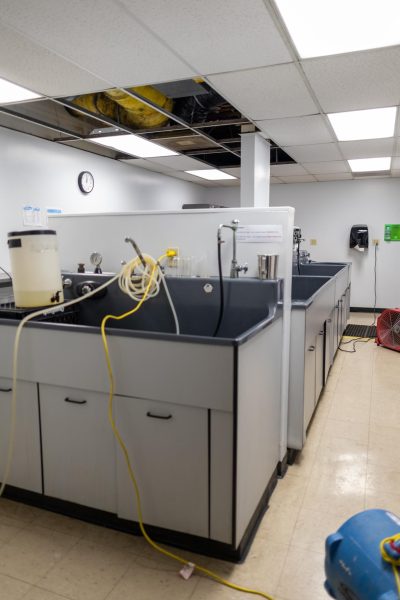
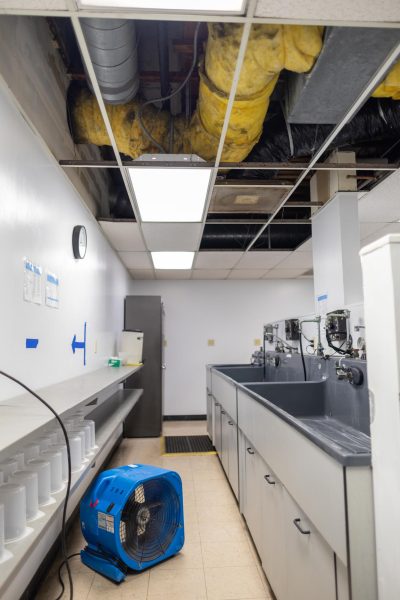
By the time the water was switched off, the flooding had penetrated through three floors and all the way to the basement, where it “deeply impacted” the film processing room and the on-campus dark room for the arts department film camera classes, according to Photography Lab Technician D. Hill.
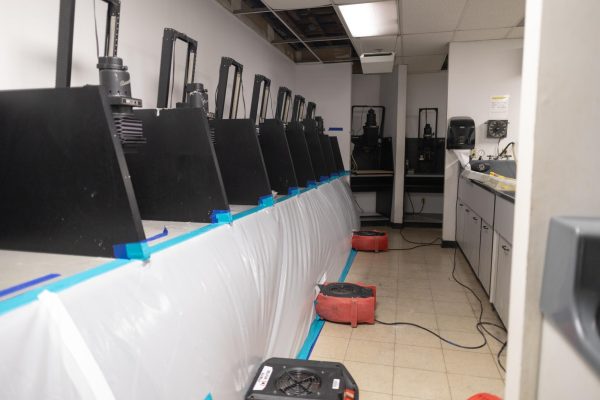
However, the full extent of the damage is not clear and will not be for a while as the repair and cleanup process continues in the basement and other areas, according to Hill.
The one film class taught on campus is now having to shift away from film cameras. They will now focus the remainder of the semester on using digital cameras in the non-impacted digital photo labs, so that students can continue to learn the fundamentals of photography and to take photos.
Hill said that the water at its strongest during the flooding in the basement poured and poured, saying that it was way more than what “one trash can, pot or pan could handle.”
“It’s like looking at something you care about and you can’t do anything about it,” Hill said.
Some speculate that the incident may have been an act of vandalism because of how these showers are operated, due to how long the shower was left on.
“Currently, the university is proceeding under the assumption this was accidental,” Hollins said. “If the facts from the RMEHS review support Public Safety, Human Resources Management, or Student Conduct involvement, those departments will follow their own investigatory due process.”
In addition to the presumption that the incident was accidental, RMEHS “is reviewing the incident from a safety and risk perspective to identify lessons learned and any preventative measures going forward,” Hollins said.
But one professor, Kimo Yap, who teaches in the Chemistry Department said that the emergency showers in the BSB do not have automatic shutoff mechanisms and must be turned off by someone. This was not independently confirmed by the UT.
Yap added that the school’s Facilities Department took a while to respond, and said that other calls had come in, but there was no real timeline established by the UT after the school, other professors and the Dean of the NSS Department did not elaborate or give any concrete details.
Yap also lost access to his office because of its proximity to the flooding and has been using the BSB lobby for office hours, where a small whiteboard was present with teaching notes and chemical formulas during the brief UT interview.
“I actually walked down the hall and heard a lot of water running from behind the closed locked office doors,” Yap said. “Kind of like a sink overflowing kind of sound. Or somebody drowning in the bathtub if you’re into horror movies.”
Professors with office spaces like Yap, impacted by the prolonged closure, are working with department chairs to determine other locations for temporary spaces either within the building or elsewhere on campus if there is no remaining space in the BSB, according to McCurdy.
The Biological Sciences building was originally constructed in 1968 and is set for wide-ranging renovations, including “accessibility upgrades, elevators, HVAC, electrical and lighting systems, plumbing, and fire/life safety,” according to the Cal State Five Year Plan which focuses on needed and future facility upgrades and planned changes to campus buildings across the 22-school system for the 2024 to 2029 timeframe.
In addition to base-level facility upgrades and improvements, “the project will also provide modernized spaces to support cutting-edge techniques and technologies in areas of molecular, cellular, and developmental biology.”
The renovations and the upgrades do not yet have an estimated cost in the plan, and it is not clear when renovations like these would actually take place in this timeframe. It is also unclear how much these immediate repairs to the structure are costing Cal State LA. The university could not officially provide an estimate by the time this story went to print, as it was too early in the clean-up and repair process to have any conclusive figures, according to Hollins.
Other structures in the same plan were listed as having “critical structural repair and water intrusion,” but were not due to accidental flooding events like the one in the BSB.
“These are primarily related to the roofing repair and replacement projects campuswide, most notably King Hall and the University Library,” Hollins said. “Additionally, the university is completing waterproofing and drainage repair for Greenlee Plaza/Parking Structure B.”